
by Günter Bischof
Dieter Stiefel, who recently died and who was buried today in his hometown of Brunn am Gebirge, was a good friend. He was born in the German town of Burghausen and first did an apprenticeship in the tourism trade, which also brought him to Paris. This background instilled in him a lifelong passion for cooking. I first met him at Harvard University, where he visited in 1986 when I was a graduate student there, working on a PhD in History with Charles Maier, who became a friend of his.
In the spring of 1989 he was a research fellow at the Center for European Studies. He was never one to just do research. While at Harvard he negotiated with the Kennedy School to start an Austrian fellowship program that would become known as “Schumpeter Fellowships” (named after the well-known Austrian economist Joseph Schumpeter who taught at Harvard from 1932 to 1950). When Stiefel returned to Vienna, he initiated the “Schumpeter Society” and raised the money from private sources to send the Austrian Schumpeter Fellows well-endowed to Cambridge, MA. He also organized the annual selection of Schumpeter Fellows.
Stiefel was a well-known economic historian. After doing his Matura late in life, he spent much of his career at the Hochschule für Welthandel (it is known as the “University for Economics and Business Administration,” one of the largest Business Schools in the world). He received a doctorate in business administration from that school (1974) and did his Habilitation there with Herbert Matis, his life-long mentor (1986). He then did a doctorate in history at the University of Vienna (1978), where he ended up teaching 20th century Austrian economic history at the Institute for Social and Economic History later in life, after his assistant professorship at the Hochschule für Welthandel. He also did fellowships, next to Harvard, at Cambridge University in England and the University of California, Berkeley.
His principal research was on the great crash of 1929 and the economic crisis years of the 1930s, but he also published some big business histories. Like on the construction company Porr (with H. Mathis), and the transportation company Schenker; he also did a biography of Camillo Castiglioni, the best-known profiteer of the Austrian inflation period after World War I. His last book was on Daniel Swarovski, the founder of a glass company that is today known as a global jewelry company. The book had a curious publication history; it was ready to be published by Böhlau, when one family member objected and the book was published years later in 2025 as Daniel Swarovski (1862-1956). In the meantime, Stiefel published a summary in English in Contemporary Austrian Studies (vol. 27) about the most controversial aspect of his career: “Swarovski and the National Socialist Era” in 2018. When I last saw Dieter and his wife Roswitha a year ago in Vienna, they proudly gave me a copy of this volume.
Dieter Stiefel also was a scholar of the Marshall Plan. We taught a seminar on the Marshall Plan in Austria together at the Wirtschaftsuniversität and in 1997 organized a 50th anniversary conference at Center Austria at the University of New Orleans (UNO). The papers of the conference were published in German as 80 Dollar: 50 Jahre ERP-Fonds und Marshall Plan in Österreich 1948-1998 (Bischof/Stiefel, eds., Ueberreuter, 1999) and in English as The Marshall Plan in Austria (Bischof/Anton Pelinka/Stiefel, eds., Contemporary Austrian Studies, vol. 8, Transaction Publishers, 2000). In 2007 we organized a conference for the 60th anniversary of the Marshall Plan in Vienna for the Austrian Marshall Plan Foundation. The papers were published as Images of the Marshall Plan in Europe: Films, Photographs, Exhibits, Posters (Bischof/Stiefel/Hannes Richter, Digital Editor, eds., TRANSATLANTICA, vol. 3, Studienverlag, 2009).
I also had the privilege to contribute to the Stiefel Festschrift: “Schumpeter versus Keynes: “Der Marshallplan und der Wiederaufbau der österreichischen Wirtschaft. Motor der Innovationsförderung und Modernisierung?”, in: Peter Berger/Peter Eigner/Andreas Resch, eds., Die vielen Gesichter des wirtschaftlichen Wandels: Beiträge zur Innovationsgeschichte. Festschrift für Dieter Stiefel (Vienna: LIT Verlag, 2011), pp. 161-180, and attend his 70th birthday party. Stiefel also invited me to give a lecture in his “Ring Lecture Series” at the University of Vienna on “The Holocaust in Austria.” I chose to lecture on the memory of Austrians on World War II: “’Opfer’ Österreich?: Zur moralischen Ökonomie des österreichischen historischen Gedächtnisses,” in: Dieter Stiefel, ed., Die Politische Ökonomie des Holocaust: Zur wirtschaftlichen Logik von Verfolgung und ‘Wiedergutmachung’. Vienna-Munich: Geschichte und Politik/Oldenbourg 2001, pp. 305-35.
I encountered Stiefel’s scholarship first as a graduate student. The first book he published was on denazification in Austria in 1980. To his credit, this book is still considered foundational in Austrian contemporary history and is cited by scholarship on the postwar occupation period. All of his work is characterized by a careful study of the primary sources (in the case of denazification in the U.S. National Archives, in the case of Daniel Swarovsky in his personal papers).
Günter Bischof
Professor Emeritus. LSU New Orleans
Director Center Austria (2001-2024)
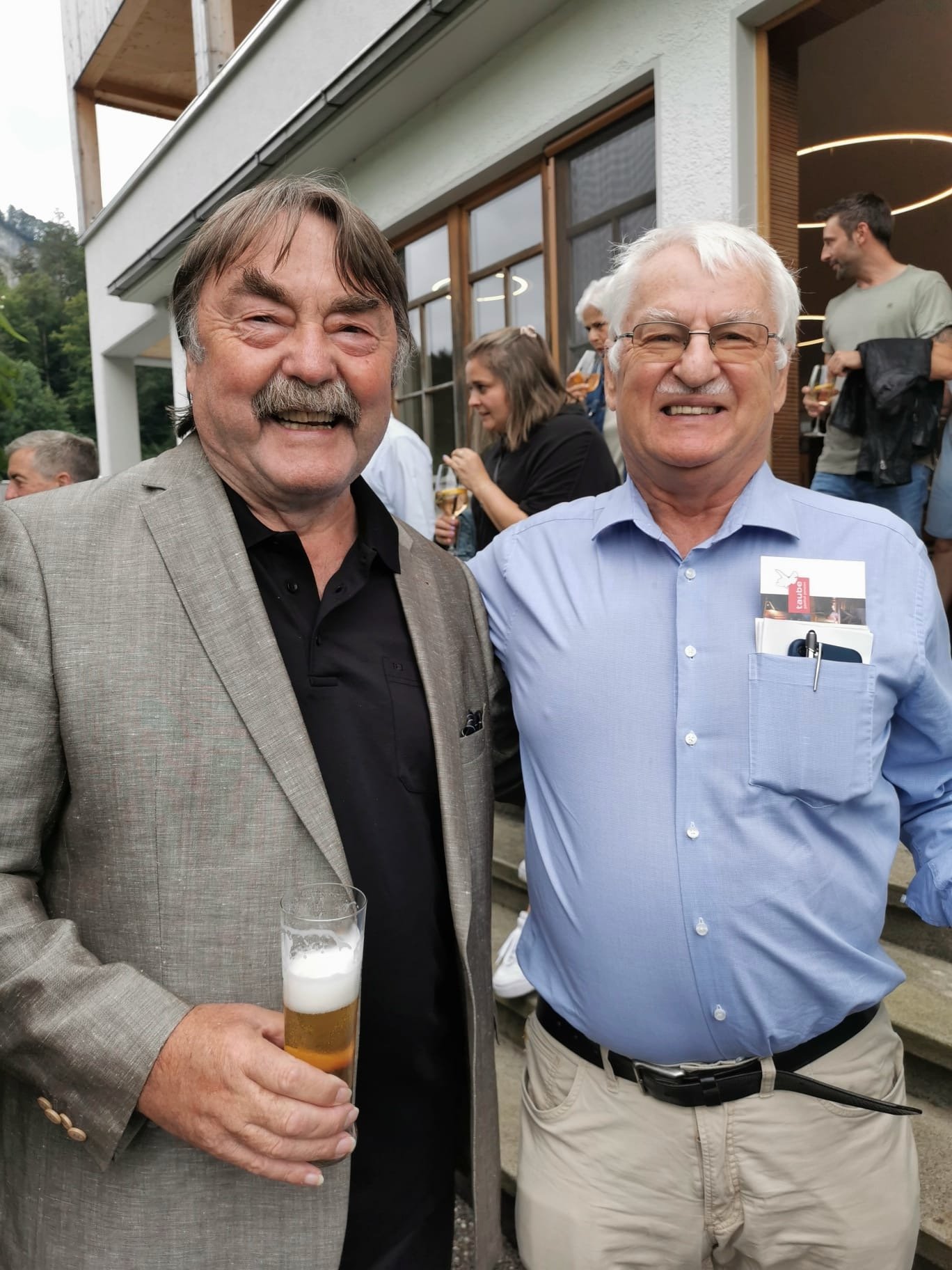
Dieter Stiefel (left) with Guenter Bischof during hiss retirement party.
Photograph by Roswitha Stiefel